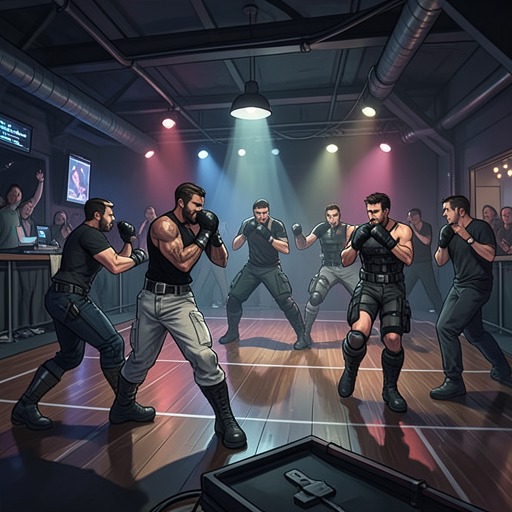
Ares Garden
𝐋𝐚𝐜𝐮𝐧𝐚 | 𝑱𝒆𝒐𝒏 𝑱𝒖𝒏𝒈𝒌𝒐𝒐𝒌Ares Garden is an illegal boxing venue concealed behind a bar in Ellensburg, and its decisive significance lies in the way it turns violence into a social world. It is at once a workplace, spectacle, refuge, trap, and measure of Jungkook Jeon’s changing identity. Under Chen’s management, the establishment makes Jungkook its emblematic champion, brings Shelby Anderson Barnum into direct contact with the underground fight circuit, and exposes the institutional corruption that allows the business to operate. Its closure, sale, reconstruction, and reopening transform the venue from a fixed setting into a recurring test: whether a place built around rage can be separated from the people and histories that gave it power.
Definition and Hidden Structure
Ares Garden operates publicly as a bar while concealing an illegal boxing arena. Chen has arranged the cover carefully: police officers come to drink, watch the fights, and accept the hospitality of the establishment, becoming corrupt participants who have no incentive to expose what happens there. The venue therefore depends on more than secrecy. Its apparent normality is sustained by a network of tolerated illegality, personal influence, and intimidation, with Chen understood as dangerous enough that the officers know better than to speak openly.
The contrast between bar and fight club defines the location’s moral architecture. Customers can gather around drinks and conversation before passing through to the arena, where a packed audience pays in dollar bills and cheers combatants toward increasing brutality. The building permits ordinary leisure to coexist with bodily harm without requiring the spectators to acknowledge the contradiction. Ares Garden’s public face does not soften its violence; it helps make that violence sustainable by presenting it as entertainment.
The venue also imposes a distinct physical route through its spaces. Shelby Anderson Barnum first enters from the street after riding her skateboard through Ellensburg, accepts a drink, and only later follows the agitated crowd toward a large door. Beyond it, she sees a prominent ring and packed stands, approaching an imposing man despite her fear. The passage from bar to arena becomes her passage from curiosity into a world whose rules she does not yet understand. The same building can therefore shift from casual refuge to threatening enclosure within a single visit.
Jungkook Jeon and the Ring
Jungkook Jeon is the figure through whom Ares Garden acquires its legend. Before one fight, he wraps bandages around his fists and wrists while the narrative places his inner demons on his shoulders, then enters the ring to the cheers of spectators throwing dollar bills. He is presented as the first fighter in every contest and as the establishment’s public image. His method is uncompromising: he fights until an opponent is unconscious. Even so, he does not want to carry another person’s death on his conscience, and Namjoon Kim understands that limit more clearly than the crowd does.
The ring offers Jungkook a form of recognition that ordinary life does not provide. The audience’s admiration and acclamations feed his pride and ego, while his dark-eyed fighter persona makes him appear almost infernal to those watching. He feels alive there, and the fights give him a means of discharging emotions that otherwise remain uncontained. Ares Garden thus rewards the very qualities that endanger him: aggression, endurance, intimidation, and the ability to convert pain into spectacle.
The venue’s training rooms reveal the cost behind that image. After seeing a familiar face that enrages him, Jungkook drives to Ares Garden, isolates himself, bands his fingers, puts on gloves, and strikes the equipment with escalating force. Each blow corresponds to a darker state of mind; he shouts, screams, and releases his rage until the “beast” within him seems ready to break out of its cage. On another occasion, he spends an hour attacking a punching bag, injuring his hands and wrists while examining their tattooed, damaged condition in the mirror. The room makes visible what the ring disguises: his champion identity is sustained through self-inflicted damage as much as through victory.
At 23:30, Jungkook prepares for a fight while Chen encourages him and Namjoon remains unusually silent. He enters beneath the red ropes, cracks his neck and fingers, and greets Andrew Wilson with a murderous look. His confidence is sharpened by the sight of Andrew’s smaller stature, which contradicts the blond man’s boasts. Yet this contest carries the residue of an earlier conflict: Andrew Wilson and his father’s henchmen have already injured Jungkook’s face, violating the fighter’s usual effort to keep his face untouched. The wounds are not merely athletic damage but the continuation of a rivalry that follows him into Ares Garden.
Shelby Anderson Barnum’s First Encounters
Shelby Anderson Barnum enters Ares Garden without knowing its full nature. She comes in from the street wanting a drink and trying to avoid the people around her. After finishing her glass and paying, she notices the customers moving toward the arena and follows them only after the passage has cleared. The crowded stands, the prominent ring, and the imposing man near it produce fear, but curiosity keeps her in place. The location’s first effect on Shelby is therefore double: it threatens her through density and spectacle while also drawing her toward an unfamiliar form of release.
The venue becomes dangerous when the crowd’s excitement turns into an assault on her sense of safety. After a traumatic encounter, Shelby is found trembling and crying in a shower room. Jungkook discovers her there, quickly turns off the water, crouches before her, and remains beside her without knowing what else to do. He does not force her to explain or touch her; his first useful action is simply to stay present until she calms. The Ares Garden changing room, normally part of the machinery of combat, becomes a temporary space in which the champion’s role is suspended and quiet endurance replaces performance.
Shelby later returns by skateboard and asks the bartender where to find Chen, proceeding upstairs to the manager’s office. Her repeated presence changes her position from outsider to participant. On a subsequent visit, she changes into sports clothes and wears worn white bandages marked by the blows she has delivered to the punching bag without gloves. The pain in her hands feels different from the pain of the blade that injured her, and she experiences the impact as a more vivid, relaxing release. Ares Garden consequently offers her a vocabulary of controlled physical exertion, even as it places that coping mechanism beside a culture that glorifies uncontrolled harm.
Her movement into the arena becomes abrupt and unauthorized. When the referee announces the next contest, Shelby climbs onto the ring before anyone can stop her. The audience, surprised, cheers her, but she freezes beneath the attention, her heart racing as she sees the size of the crowd and then her opponent: a taller, more muscular woman with pink hair and facial scars. The venue’s public ritual attempts to absorb Shelby immediately, converting her vulnerability into entertainment. The ring does not ask whether she is ready; it assumes that stepping into the space is enough to make her a fighter.
Jungkook’s response complicates that coercive atmosphere. After Shelby’s fight, he places her in an individual shower stall reserved for more private users and turns on the water, an act that surprises Namjoon. Later, he approaches her, crouches, and rests his right hand on her knees while she is seeking comfort. Their connection develops rapidly during the week that follows. Shelby remains wary of men, but Jungkook becomes a kind of refuge, and Namjoon recognizes that the two wounded people are searching for themselves while also reaching toward one another. Within Ares Garden, a site designed to organize bodies through combat, their relationship begins to organize safety through carefully limited contact.
The Venue as a Crisis Machine
Ares Garden’s most dangerous expression appears when Jungkook returns to the ring in a rage intensified by substance use and hallucinations. At 00:10, he attacks his opponent with an animal-like ferocity while Namjoon and Chen watch in growing fear. His eyes appear altered and almost glassy. He repeatedly strikes the man’s face, breaking one of his teeth, while Namjoon searches Jungkook’s belongings for his phone and calls Shelby for help.
Shelby reaches the arena through the bar’s secret passage and sees Jungkook on top of an entirely inert opponent. He is drooling from rage, unable to distinguish the fight’s ending from the need to continue it, and is unknowingly killing a man who can no longer defend himself. More disturbing still, the audience urges him onward, even toward death. The crowd reveals the final logic of the venue: once violence becomes the shared desire of spectators, the injured body is no longer treated as a person whose survival matters but as the surface on which collective excitement is maintained.
Shelby’s intervention breaks the spectacle but does not resolve its damage. Jungkook later collapses alone on the floor, covers his face, and cries over the way he has treated the one woman with whom he had begun to feel safe. In the changing room, he finds white powder scattered across the floor, recognizes it as an old substance-related relapse he had not expected to encounter again, cleans the mess, and washes before meeting Chen at the bar. Chen’s anger takes institutional form: he orders Jungkook never to set foot in Ares Garden again until he has done what is necessary to address the situation. The ban is both punishment and an emergency attempt to prevent the ring from turning one more loss of control into death.
Closure, Sale, and Institutional Consequences
The ban imposed on Jungkook does not remain the only consequence of Ares Garden’s violence. Police eventually arrive after receiving a report that Chen is organizing illegal boxing matches. When the officers inspect the premises, the concealed ring confirms the accusation, and Chen is handcuffed and taken away. The arrest exposes the fragility of the arrangement that had protected the venue: the bar’s respectable surface can delay scrutiny, but it cannot erase the arena behind it. Chen’s removal also severs Jungkook from the person who had managed both the business and his place within its underground hierarchy.
The closure is marked by bitterness rather than simple relief. Later, Jungkook and Shelby encounter Chen outside the establishment, where he tells them that he has signed the papers selling Ares Garden. He explains that he can no longer manage the business and that the buyer is a friend who will take responsibility for it. Jungkook is deeply shaken. The venue had been the place where he spent most of his time, fought, trained, and built his reputation; losing it feels like losing a damaged but central part of his own history. Chen’s embrace of both younger people makes the sale a personal farewell as well as a commercial transfer.
The building’s former protection is also linked to a wider power structure. When Chen is taken away, he sees the Rolls-Royce belonging to Bruce Wilson outside and immediately suspects that something improper is being arranged. The sight connects Ares Garden’s policing to the Wilson family’s influence, suggesting that the venue is not an isolated criminal enterprise but part of a local system in which money, intimidation, and compromised authority overlap. Its existence depends on people who profit from violence and on institutions willing to look away until the arrangement becomes impossible to contain.
Reopening Under New Ownership
Ares Garden returns under the ownership associated with Spencer Jenkins and his daughter Evie Jenkins. Jungkook learns that Spencer’s father has bought the establishment from Chen and that Spencer and Chen have been close friends for years. The business will continue, but its cover will change drastically, with the renewed venue intended to compete with The Obsidian. The reopening therefore preserves the site’s basic function while altering its public presentation and commercial position.
Spencer personally tells Jungkook that Ares Garden will reopen the following week and identifies him as the first name on the new champion’s list. He expects the public to await Jungkook’s return, and Jungkook responds that he will be pleased to return to the ring. The exchange reveals how quickly the venue can convert exclusion into invitation. After Chen’s ban, Jungkook’s fighter identity had been interrupted; under new management, that same identity becomes a resource used to relaunch the establishment.
The reopened arena is materially different from Chen’s version. The ring is raised and much larger, with red-and-black ropes. The former stands have disappeared, replaced by a VIP level belonging to the nightclub, while the audience watches from below through two large screens fixed to the wall. The change makes Ares Garden more polished and more overtly commercial without removing its core spectacle. Violence is not abandoned; it is redesigned, framed, and sold through a new architecture of visibility.
Admission also becomes more controlled. Jungkook notices that attendees bear a Corinthian helmet mark on one hand, a requirement for access to the illegal fights that Chen had never imposed. The mark turns entry into a visible sign of belonging and exclusion. It also gives the rebuilt venue a ritualized identity: spectators do not merely enter a bar or purchase entertainment but display evidence that they are permitted to participate in the hidden community surrounding the fights.
Jungkook’s Return and Rejection of the New Order
The reopening confronts Jungkook with a conflict between attachment and judgment. Sitting in his car outside, he hesitates because he knows exactly what Ares Garden provides. He loves the illegal fights, the release they offer, the sensation of being alive on the ring, and the admiration that feeds his pride. The hesitation is not uncertainty about the venue’s appeal but recognition of its power over him. Ares Garden remains capable of summoning the older Jungkook who measured vitality through pain, fear, and public acclaim.
When Spencer leads him inside, Jungkook sees the transformed arena and is immediately absorbed by the spectacle of its renewal. The larger elevated ring, the dark and red ropes, the screens, and the arriving crowd create a more elaborate version of the world that once made him its emblem. As he descends, spectators acclaim him, and the familiar reaction confirms that his reputation has survived the transfer of ownership. The champion returns not to an unchanged room but to a rebranded machine that still recognizes the body and legend it helped create.
Jungkook ultimately contests the claim that the rebuilt venue can inherit Chen’s legitimacy merely by changing its appearance. He explains that Sunmi Eun is teaching him to become healthier and more thoughtful, rejecting the idea that such change makes him weak. He insists that he remains Ares Garden’s champion and that Chen will always be its founder, while declaring that the new owners are no more worthy of the place than Bruce Wilson. His response separates the institution’s historical identity from its physical renovation: new ownership can alter the ring, cover, and rules of access, but it cannot purchase the moral authority created by Chen’s history with the fighters.
This confrontation also makes Ares Garden a measure of Jungkook’s recovery. Earlier, the venue rewarded his rage until he nearly killed an unconscious opponent and relapsed into cocaine use. Later, his attachment to the ring remains powerful, but he can name the cost of returning to it and defend the emotional work that is changing him. The location therefore holds two versions of his identity at once: the celebrated fighter who once treated violence as release and the man attempting to understand strength as restraint, reflection, and responsibility.
Narrative Significance
Ares Garden is the book’s most concentrated space of contradiction. It is a bar and an illegal arena, a social meeting place and a site of concealment, a source of income and a mechanism of bodily destruction. Its hidden passage draws Shelby Anderson Barnum from ordinary drinking into an environment where spectators cheer an incapacitated man’s possible death. Its shower and training rooms, however, also contain the first awkward gestures through which Jungkook offers Shelby presence, practical care, and limited physical reassurance. The same architecture can therefore produce danger and shelter, depending on whether its inhabitants are performing violence or interrupting it.
The venue’s relation to Shelby and Jungkook changes as their relationship changes. Shelby first encounters it as an outsider, then returns to seek Chen, trains there, and enters the ring before she understands what participation will demand. Jungkook first appears as the establishment’s violent symbol, but his concern for Shelby makes him act against the venue’s usual logic by remaining beside her when she is unable to tolerate touch and by helping her recover after the fight. Their bond exposes an alternative use for a place built around domination: not the erasure of vulnerability, but the recognition of it.
Ares Garden also links private trauma to public systems. Jungkook’s childhood violence, anger, substance abuse, and repeated injuries are converted into entertainment for a paying crowd. Shelby’s need for controlled pain and her fear of unwanted contact enter the same environment, where the distinction between chosen exertion and coercive harm is constantly threatened. Police corruption allows the venue to continue, Chen’s arrest reveals the cost of that impunity, and the sale demonstrates how quickly an illicit institution can be absorbed into a new commercial structure.
Its reopening prevents the location from functioning as a simple symbol of a past that has been overcome. Ares Garden survives Chen’s arrest, Jungkook’s exclusion, and the change of ownership. The ring is enlarged, the audience is reorganized, admission is marked, and competition with The Obsidian is announced, yet the old appetite for combat remains. The place’s persistence gives the narrative a durable question: whether transformation belongs to the building, the institution, or the people who must decide what its power will mean. For Jungkook, the answer cannot be settled by returning to the ring. Ares Garden remains the arena in which his violence was celebrated, his crisis became visible, and his emerging restraint was forced to declare itself.